
Why Content Planning Determines Ranking Speed
Search engines do not rank articles.
They rank authority networks.
When Google evaluates a page, it does not isolate it. It evaluates:
- How deeply you cover the topic
- How your pages connect
- Whether you demonstrate expertise
- Whether your content cluster is coherent
Random publishing creates scattered authority.
Structured publishing creates gravitational pull.
AI dramatically reduces the friction of planning — but you must understand what you’re building.
You are building:
- A pillar page (your authority center)
- Supporting cluster pages
- Internal links reinforcing semantic relationships
- Conversion pathways embedded across the system
That is not blogging.
That is architecture.
The 90-Day AI Content Strategy Framework
Ninety days is the perfect planning window.
It is long enough to build authority signals.
It is short enough to maintain focus.
Here is the strategic objective of your first 90 days:
- Publish one pillar page.
- Publish 12–20 supporting cluster articles.
- Establish internal linking loops.
- Capture email subscribers.
- Begin monetization testing.
AI enables you to plan this in hours instead of weeks.
But planning must be layered.
Let’s break it down.
Defining Your Core Pillar for Content Planning
Your pillar page is not just long content.
It is your topical flagship.
Example:
“AI for Profitable Blogging”
This pillar:
- Targets a high-value primary keyword.
- Covers the topic comprehensively.
- Links to supporting articles.
- Converts readers into subscribers.
AI can help outline and expand it.
But first, you must define its cluster ecosystem.
Creating Topic Clusters Within Content Planning
Topic clustering is the foundation of modern SEO.
A cluster consists of:
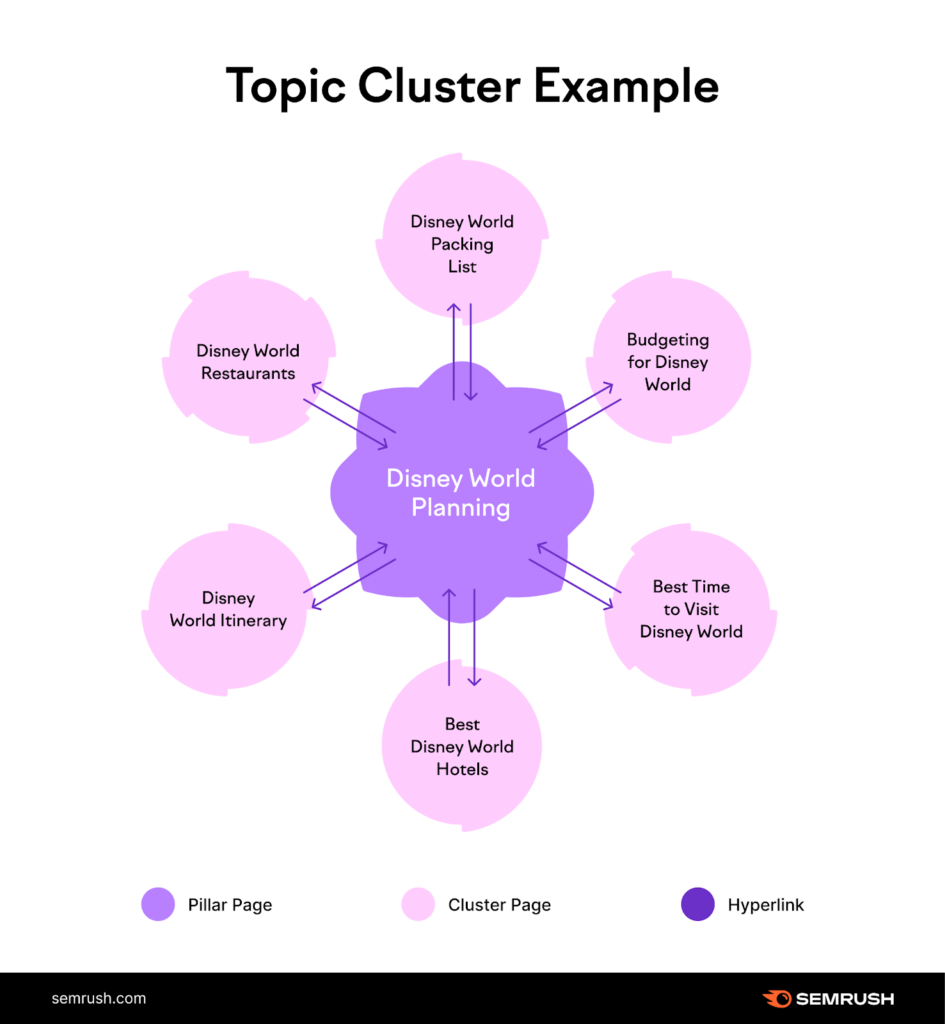
- One comprehensive pillar page
- Multiple supporting articles
- Internal links between them
Search engines interpret clusters as expertise signals.
Let’s illustrate conceptually:
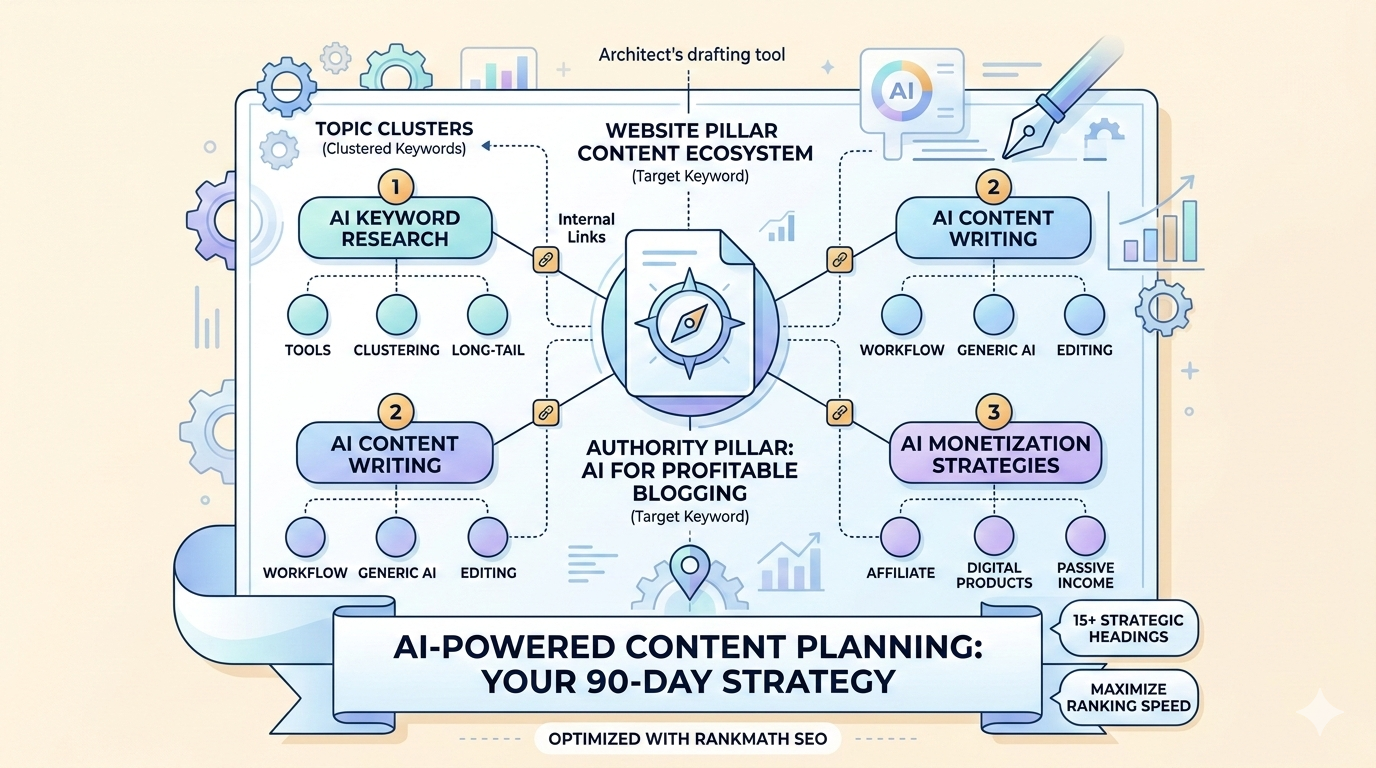
Pillar: AI for Profitable Blogging
Cluster 1: AI Keyword Research
Cluster 2: AI Content Writing
Cluster 3: AI SEO Optimization
Cluster 4: AI Monetization Strategies
Cluster 5: AI Blog Automation
Each cluster supports the pillar.
Each cluster article links back to the pillar using anchor text:
“AI for profitable blogging”
This creates reinforcement.
Using AI to Generate Cluster Maps
Instead of brainstorming manually, use prompts like:
“Create a topical cluster map for the keyword ‘AI for profitable blogging’ including one pillar and at least 20 supporting articles.”
AI will generate structured groupings.
Now refine.
Ask:
- Are these keywords aligned with search intent?
- Are commercial pages included?
- Are informational articles supporting them?
You are curating structure, not copying output blindly.
AI Keyword Clustering for Scalable Content Planning
This is where AI shines.
Traditional keyword clustering required:
- Exporting keyword lists
- Sorting manually
- Grouping by similarity
AI can:
- Analyze semantic similarity
- Group related long-tail queries
- Suggest cluster boundaries
- Identify orphan keywords
Example:
Cluster 1: AI Keyword Research
- Best AI keyword research tools
- How to use AI for SEO keyword clustering
- AI vs traditional keyword research
- AI keyword tools for bloggers
- Long-tail keyword generation using AI
Cluster 2: AI Content Writing
- AI blog writing workflow
- Best prompts for AI blog content
- Avoiding generic AI content
- AI content editing strategies
- Human + AI hybrid writing model
Cluster 3: Monetization with AI
- AI affiliate blog strategy
- Creating digital products using AI
- AI email funnel automation
- Passive income blogging with AI
Now each cluster becomes a mini authority silo.
Designing the Content Planning Publishing Calendar
Publishing without structure leads to fatigue.
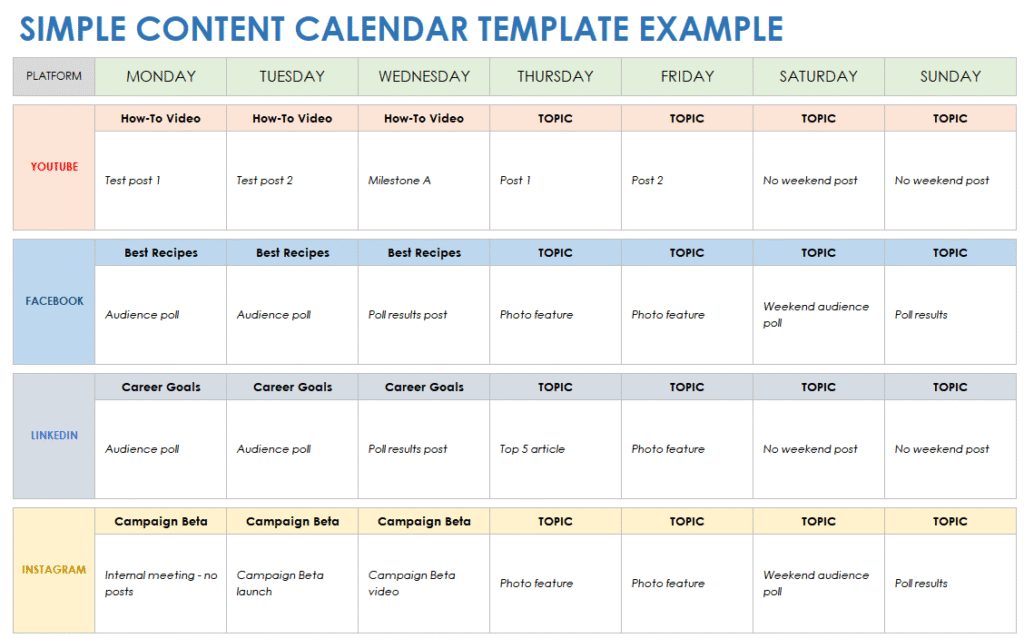
Instead, define weekly rhythm.
Example 4-Post Weekly Model:
Week Structure:
- 2 Informational articles
- 1 Commercial-intent article
- 1 Update/refresh article
Why this works:
Informational content builds traffic.
Commercial content builds revenue.
Updates strengthen rankings.
Consistency builds algorithm trust.
AI helps draft outlines and accelerate production.
But the rhythm is strategic.
Sample 4-Week Content Plan
Week 1:
- What Is AI for Profitable Blogging?
- Best AI Keyword Research Tools for Bloggers
- AI Affiliate Marketing Strategy
- Update: Improve Internal Linking in Pillar
Week 2:
- AI Content Writing Workflow Explained
- Avoiding Generic AI Blog Content
- Make Money Blogging with AI
- Refresh: Add FAQ Schema to Pillar
Week 3:
- AI SEO Optimization Guide
- How to Cluster Keywords Using AI
- Creating Digital Products from Blog Content
- Update: Improve Meta Descriptions
Week 4:
- AI Blogging Automation Systems
- AI for Email Marketing Funnels
- Affiliate Comparison Post
- Content Audit Review
This is not random.
It is ecosystem growth.
Intent Balancing in Your Content Planning
Every 90-day plan must balance:
- Top-of-funnel (informational)
- Middle-of-funnel (comparative)
- Bottom-of-funnel (commercial)
If you only publish informational posts:
Traffic grows. Revenue stalls.
If you only publish commercial posts:
You lack traffic volume.
AI helps categorize keywords by intent.
Your plan should deliberately include:
- Awareness topics
- Comparison topics
- Product-specific topics
- Monetization tutorials
Strategic balance compounds faster.
Internal Linking Architecture and Content Planning
Internal linking is not an afterthought.
It is a planning requirement.
For every new article, ask:
- Which pillar does this support?
- Which 2–3 existing articles should it link to?
- Where does it fit in the hierarchy?
AI can suggest internal link placements based on topic similarity.
But you must ensure:
- Anchor text variety
- Natural placement
- Contextual alignment
This transforms scattered content into structured authority.
Integrating Conversion Paths Into Content Planning
Content without conversion infrastructure is incomplete.
Before publishing:
- Where will the lead magnet appear?
- Which articles push to affiliate pages?
- Where does the email capture form sit?
- Which posts include product CTAs?
AI can help draft:
- Lead magnet descriptions
- Email sequences
- Conversion copy
But you must design the flow.
Traffic → Email → Offer.
Content planning includes funnel planning.
Depth Strategy for High-Level Content Planning
Search engines reward depth.
AI can generate volume.
But depth requires:
- Examples
- Data
- Screenshots
- Case scenarios
- Clear frameworks
For each cluster article, define:
- Primary keyword
- Secondary keywords
- Core user problem
- Monetization opportunity
- Internal link targets
That level of pre-definition reduces weak articles.
Scaling With Batch Content Planning
One major AI advantage is batch processing.
Instead of planning weekly:
- Generate 50 keyword ideas.
- Cluster them.
- Select 20.
- Outline all 20 in one session.
- Schedule production.
Batch planning increases strategic coherence.
It prevents reactive publishing.
Consistency becomes easier.
Velocity and Quality Control in Content Planning
AI allows higher output.
But output without refinement destroys credibility.
Use this workflow:
- Human defines intent.
- AI drafts outline.
- AI expands draft.
- Human refines.
- AI optimizes.
- Human finalizes.
Planning includes defining this workflow upfront.
Otherwise, quality fluctuates.
The Authority Compounding Effect
When content is structured:
- Each article strengthens others.
- Rankings improve faster.
- Time on site increases.
- Trust compounds.
Imagine 20 isolated articles versus 20 clustered articles.
Clusters win.
AI makes clustering accessible to solo bloggers.
That changes the competitive landscape.
Common Content Planning Mistakes
- Publishing before cluster mapping.
- Ignoring internal linking.
- Overloading informational content.
- Not planning monetization early.
- Chasing trending keywords randomly.
Planning reduces these errors dramatically.
The Strategic Outcome of Your Content Planning
Google’s Search Essentials on helpful content
By the end of your 90-day plan, you should have:
- One authority pillar
- 15–20 structured cluster articles
- Clear internal linking loops
- Embedded conversion paths
- Consistent publishing cadence
- Defined monetization integration
That is not just a blog.
That is an authority ecosystem.
AI reduces friction.
Planning determines power.
In the next section, we move from planning to execution — where AI helps you write high-quality SEO blog posts that rank and convert.
Structure first.
Execution second.
That is how profitable blogging scales.