
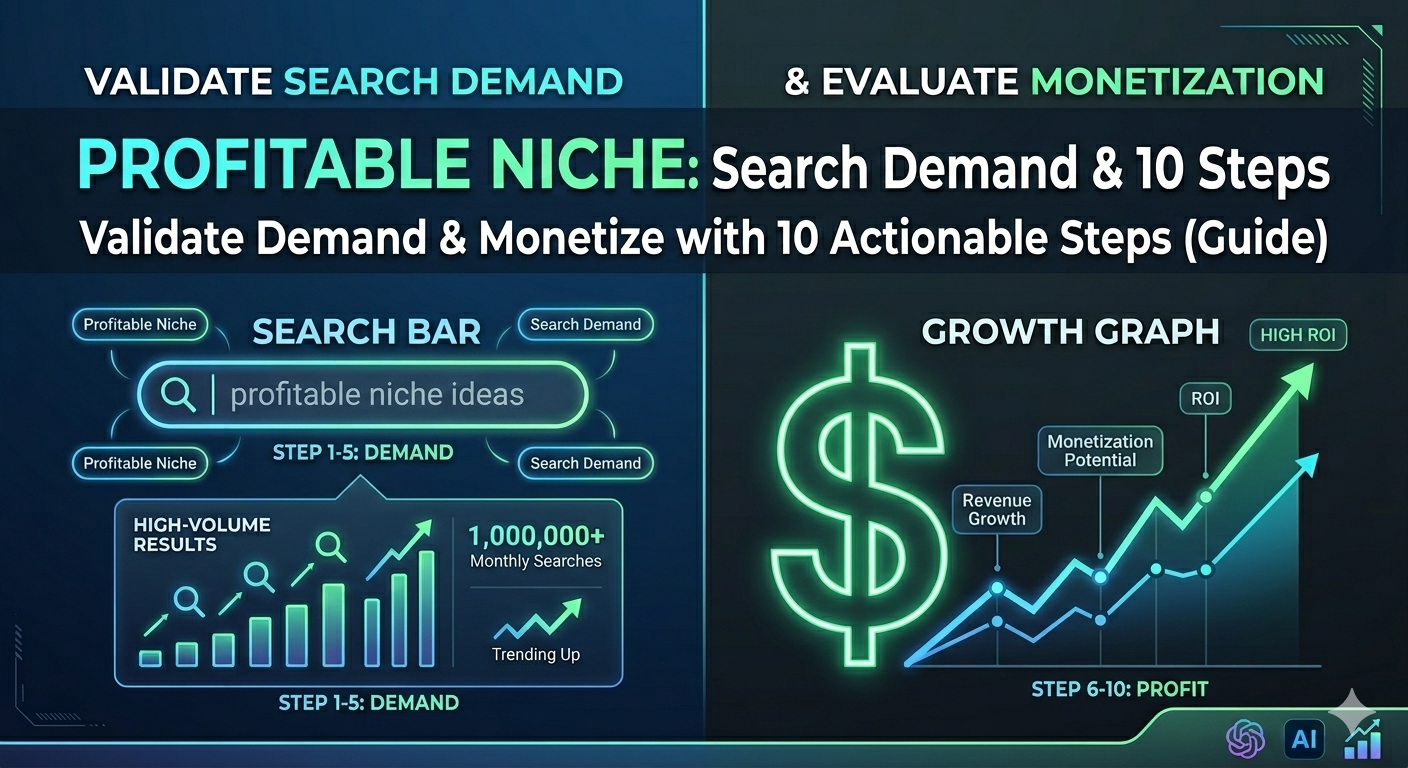
Why Profitable Niche Selection Is the Most Important Strategic Decision
Every successful blog is built on leverage.
Leverage comes from:
- Focused authority
- Search engine clarity
- Audience specificity
- Monetization alignment
A Profitable niche is not just a topic.
It is a defined problem space with economic gravity.
If your niche is too broad, you compete with corporations.
If your niche is too narrow, you lack demand.
If your niche has no monetization, traffic becomes decorative.
The goal is not to find a niche that sounds exciting.
The goal is to find one that satisfies three conditions:
- Demand exists.
- Competition is beatable.
- Money flows within the ecosystem.
AI accelerates discovery, but you must evaluate strategically.
What Is a Profitable Niche, Really?
A profitable niche has:
- Recurring problems
- Active buyers
- Ongoing search behavior
- Product ecosystems
- Expanding market signals
It is not defined by how many people are interested.
It is defined by whether solutions require spending.
For example:
“Daily motivational quotes” may attract traffic.
“Best AI tools for content creators” attracts buyers.
Traffic alone is insufficient.
Buyer behavior matters.
Generating Profitable niche Ideas Using AI
The first role of AI is expansion.
Instead of brainstorming manually, you use structured prompts to explore profitable opportunity spaces.
Example Prompt 1: Broad Expansion
“Generate 30 blog Profitable niche ideas with strong monetization potential in 2026, focusing on digital products or affiliate marketing.”
AI will produce ideas across industries.
Now refine.
Example Prompt 2: Sub-Niche Expansion
“List underserved sub-niches within personal finance that have high buyer intent and digital product opportunities.”
You are now narrowing scope.
This is where opportunities emerge.
Example Prompt 3: Emerging Trends
“Identify emerging markets where AI adoption is increasing and consumers are actively purchasing tools or services.”
You are now looking for trend leverage.
Example Prompt 4: Problem-Profitable niche
“List common recurring business problems entrepreneurs search for that have associated paid solutions.”
Problems convert better than interests.
Example Prompt 5: Buyer-Intent Mapping
“For the niche ‘remote work productivity,’ list 20 high commercial intent keywords.”
You are now testing economic gravity.
AI allows you to generate structured opportunity maps quickly.
But generation is only the first step.
Validating Search Demand: The Key to Identifying a Profitable Niche
Idea generation is imagination.
Validation is reality.
Demand is measured through:
- Search volume
- Keyword consistency
- Trend stability
- Related query clusters
Search Volume
High volume suggests strong interest.
But high volume alone does not guarantee profitability.
Low-volume long-tail keywords often convert better.
For example:
- “Blogging tips” — broad, competitive.
- “Best AI tool for affiliate blog SEO” — narrower, higher intent.
AI can help cluster long-tail variations to reveal real demand patterns.
Keyword Difficulty
You must evaluate competition strength.
Indicators include:
- Domain authority of competitors
- Backlink profile
- Content depth
- SERP features (ads, videos, featured snippets)
AI tools summarize competitor strengths and weaknesses quickly.
The strategic question is:
Can you create something better, deeper, or more structured?
If yes, competition is not a barrier.
Search Intent Analysis
Search intent falls into four categories:
- Informational
- Navigational
- Commercial
- Transactional
Profitable blogs mix informational and commercial intent.
Informational content builds traffic.
Commercial content drives revenue.
AI can classify search intent patterns and group keywords accordingly.
From Validating Search Demand to Evaluating Monetization Potential: Your Roadmap to a Profitable Niche
Demand without monetization is wasted energy.
You must evaluate:
- Are products sold in this niche?
- Are affiliate programs available?
- Are competitors monetizing?
- Are digital products common?
- Are recurring subscriptions present?
Let’s build a scoring framework.
Niche Evaluation Matrix
| Niche | Demand | Competition | Monetization | Scalability | Score |
|---|---|---|---|---|---|
| AI Blogging | High | Medium | High | High | 9/10 |
| Meditation Quotes | Medium | High | Low | Low | 4/10 |
| SaaS Review Blog | High | Medium | High | High | 8.5/10 |
| DIY Crafts | High | High | Medium | Medium | 6/10 |
This type of matrix removes emotion from decision-making.
AI can help you fill it faster, but your judgment must interpret it.
Avoiding the Passion Trap
Many bloggers choose profitable niches based purely on interest.
Interest helps consistency.
But passion without economic potential leads to frustration.
The better framework is:
Interest + Market Demand + Monetization = Sustainable Motivation
You do not need to be the world’s top expert.
You need to:
- Research deeply
- Provide clarity
- Deliver structured value
AI reduces the barrier to learning and content production.
That makes entering semi-competitive niches viable.
The Micro-profitable niche Strategy
Instead of targeting:
“Fitness”
You target:
“Home strength training for busy professionals over 40”
Instead of:
“Technology”
You target:
“AI productivity tools for solopreneurs”
Micro-niches allow:
- Faster authority building
- Lower competition
- Stronger audience connection
AI can help identify micro-niche patterns by analyzing long-tail search clusters.
Micro-niches are easier to dominate.
Once authority grows, you expand outward.
Competitive Landscape Analysis with AI
AI can summarize competitor websites by analyzing:
- Content depth
- Posting frequency
- Monetization methods
- Internal linking patterns
- Content gaps
You look for:
- Topics poorly covered
- Outdated articles
- Weak internal structure
- Missing monetization layers
Opportunity often hides in execution gaps, not idea gaps.
Long-Term Scalability Check
Ask:
- Can this niche expand into multiple content clusters?
- Can you create digital products?
- Are recurring problems present?
- Does the market grow yearly?
Trendy niches burn out.
Evergreen niches compound.
AI trend analysis tools help identify:
- Rising queries
- Seasonal patterns
- Declining topics
Strategic bloggers avoid shrinking markets.
Revenue Path Alignment
Before finalizing your niche, decide your primary monetization model.
For example:
If affiliate marketing is your model:
Choose niches with expensive products and strong commission structures.
If digital products are your model:
Choose niches where education and templates are valuable.
If services are your model:
Choose niches where expertise is scarce and high-value.
Monetization clarity narrows niche decisions dramatically.
Testing Before Committing
You do not need blind faith.
You can test:
- Publish 5–10 cluster articles.
- Measure early indexing.
- Observe impressions.
- Analyze click-through rate.
AI accelerates this testing phase by reducing production time.
Early data informs refinement.
The Niche Commitment Principle
At some point, you must commit.
Constant niche switching kills authority.
Search engines reward topical consistency.
Audience trust builds through repetition.
Once you validate:
- Demand
- Competition feasibility
- Monetization pathways
Commit and build clusters.
Authority compounds through depth.
Common Niche Mistakes to Avoid
- Choosing ultra-broad categories
- Ignoring monetization feasibility
- Underestimating competition
- Jumping on short-term trends
- Abandoning niche too early
AI reduces research friction.
It does not eliminate strategic patience.
Realistic Example: Applying the Framework
Let’s hypothetically evaluate:
“Niche: AI Tools for Content Creators”
Demand:
High — rising interest in AI tools.
Competition:
Medium — but fragmented.
Monetization:
Strong affiliate programs, digital products, consulting.
Scalability:
High — expands into tutorials, comparisons, case studies, templates.
Verdict:
High potential.
This is how you think systematically.
The Strategic Payoff
Choosing the right niche does three things:
- Makes SEO achievable.
- Makes monetization natural.
- Makes scaling possible.
The wrong niche creates friction at every stage.
AI gives you speed.
Strategy gives you direction.
Direction determines outcome.
In the next section, we build your 90-day AI-powered content strategy — where niche clarity becomes structured authority.
Niche selection is the map.
Content architecture is the journey.